Flexibility is the new strength. Mindfulness and meditation are not optional; they are the price of admission.

The Therapy is Dandy Guide to Having a Parent for a Narcissist. Chapter 25.

This is the blog where I tell you nothing is free. If you want to improve your relationship to your own feelings and your relationship to people in your life—narcissistic parents, or loved ones, or your favorite bartender—then it is going to take focus and concentration.

This week lots of people have been focused on eating an ugly bird and shopping. And it is commonly heralded as the beginning of the most stressful part of the entire year.

And that’s entirely our fault.

Focus and concentration.

Do we address the real needs of the people in this world, or do we want to buy a cheap toaster oven? Do we learn to talk about our feelings with our loves ones, or do we hide at the bottom of work, petty distractions, sports events, or some addictive behavior?

Holidays are a tough time for adult children of narcissists. It’s even more difficult to focus on finding joy and pleasure when navigating toxic family memories and our own hastily constructed boundaries and defensives.

So, the holidays are full of shopping and eating, Henry. What’s the big deal?

The big deal is that for many of us shopping and eating become secondary rewards. Rather than get the emotional understanding or peace I am seeking, I can eat this lasagna and get instant gratification. And buying that new suit will temporarily make me feel pretty good. So we keep shopping and eating. Meanwhile our self acceptance rarely improves. And based on the obesity and bankruptcy statistics for America, we don’t know how to stop eating and shopping before it gets out of hand. A pretty vicious cycle.

It would be great if we could track our own progress of mindfulness and mental clarity like the way they do in video games. If it was just a linear progression of leveling up skill points and character traits, well, I would know exactly how much work I needed to put in to this mindfulness crap before I got to level 5. It would be so easy!

But this is not an episode of bad TV where tech geeks decide they know what is best.

Because this is a big topic and I clearly am just brushing the top of it, I am going to have to pull out my heavy weapon and talk about Bruce Lee (again). Bruce was five foot seven and weighted 135 pounds at his best. He argued it wasn’t strength or size that made fighters win, but speed. And he had speed. In the counseling world, I translate his speed comment to reactivity and awareness. How quickly can one intercept negative self talk and vanquish it, rather than give in and eat a third piece of chocolate cake, or buy the expensive gas grill/hibachi combo? When you feel threatened by a comment your patner makes, can you breathe into your fears and respond with an open mind rather than angry words? Bruce Lee practiced every day. And so should all of us.

Here is a cheat sheet of things you should already be doing. You can find these lists everywhere. So, it’s not that no one knows, it’s that no one keeps up with it. Which makes sense. I have a video game I could be playing right now. And you have, you know, other stuff to go do.

Practical steps to self care:

  1. If it feels wrong, don’t do it.
  2. Say exactly what you mean.
  3. Don’t be a people pleaser
  4. Never speak bad about yourself.
  5. Never give up on your dreams
  6. Don’t be afraid to say no.
  7. Don’t be afraid to say
  8. Be kind to yourself.
  9. Let go of what you can’t control
  10. Stay away from drama and negativity.

Posted in Mental health therapy | Tagged , , , , , , , , , | Leave a comment

The Holy Grail, Unicorns, Bigfoot, Narcissists who validate our feelings, and other mythical inventions that do not exist.

The Therapy is Dandy Guide to Having a Parent for a Narcissist. Chapter 24.

Well, well. Look what’s back. “Just when I thought I was out, they pull me back in!”

The thing about writing about narcissists that I have discovered is that it helps get me in touch with my anger. (Some might say too much in fact.) Actually all the writing I do gets me in touch with some emotion. It’s a way I have personally discovered of uncovering my own emotionally camouflaged language and/or reactions. So, when I don’t write, I lose access to one way of expressing powerful emotions. So, this one has been building up for most of this past year.

Isn’t all artistic expression an attempt to communicate something about life, something deeply emotional, something—dare I say—important? If you disagree, you can stop reading now. Really. Stay repressed but angry at yourself.

So, I somehow I have come back around and feel justified about writing about narcissists and all their crap. I don’t know if that is a good thing for you or me, or maybe both.

I sound so bratty! It’s because I am angry, dear readers. But not at you. I am angry at the deficits that growing up around narcissists can cause. I am angry at how long of a shadow those deficits can cast, and how much time it takes to recover and move on from that damage. And I am guessing that you are too. Even if you don’t know it yet.

So that’s where I can try to do my thing.

Narcissists will rarely if ever know how to validate our feelings. They don’t really do other people’s feelings—except in order to better manipulate us into getting whatever they want. And validating another person’s emotional experience is a really important part of a healthy and happy life. And it’s a really important skill for a parent to model and pass on to their children. Its absence can be devastating. If we don’t get our emotional selves validated by our parents, then we grow up not really knowing how to validate ourselves. So, if we feel bad, we can tend to blame ourselves, rather than the environment or the actual cause of our bad feelings. We internalize everything because no one showed us that we had other options.

When we get older and start having relationships and families of our own, we may not do so well at validating other people’s feelings. Because, remember, it was never really modeled for us. So, our partners may think we are aloof, or insensitive, or not caring. We may be really good at problem solving, but problem solving is just one thing, it isn’t the holy grail of relationships. Validating another person’s experience and emotion—even if you completely disagree with them—is far more important than being Mr. or Mrs. Fixit.

A possible reason adult children of narcissists are so drawn to being Mr. or Mrs. Fixit is because solving problems is so validating to their needs. Needs that—remember—were never or quite poorly validated. And for an individual with a sense of self that may be lacking in confidence, even possibly prone to an anxious or avoidant attachment style, problem solving can feel like the best thing ever. But it’s just one thing. And there are a lot of other great things that we get into these complicated relationships for in the first place. Right?

So you have to ask yourself a couple of questions: how much of a problem solver are you? What is it like for you not to solve problems? How good are you at validating people’s emotions (including your own)? Is there someone in your life right now who keeps telling you that you just “don’t understand them?” or, i.e. are not validating their emotional experience?

If so, then you have a condition, son.

More on this next time.

Thanks for hanging in there with me.

Posted in Adult Children of Narcissists, Mental health therapy | Tagged , , , , , , , , , , | 2 Comments

Summertime Blues, Loss and Depression

I know, I know. I hate the title of this one too. The good news is that after this post, you will see much less of a mopey attitude. Promise.

Today’s enemy, today’s sermon, today’s you-get-points-for-just-reading, is all about unexpressed or unaware emotion—emotion that can come out in what I have called Emotionally camouflaged language.

Anger.

Maybe I have talked about it before, but it’s like a drop in the bucket. Seriously. Anger is a huge topic, and it is a little daunting even trying to briefly get into it.

Anger is one of those really interesting topics. Not only is it by nature reactive, but people’s behavior towards anger can also be quite reactive. Most of us have a lot of personal history, including pain, fear and regret around the topic. Even if a person doesn’t share any of it with you directly; our attitudes around anger affects all of us.

So, yes, Anger is the big topic for the day (and future posts) and the antidote to what is ailing perhaps many of us.

It seems that many of us are taught explicitly, or learn by example and many forms of social coercion that being angry is somehow bad, or wrong, or inappropriate. It is fair to say women and minorities get even more social programming around anger and expressing anger that causes additional kinds of repression, or lack of know how in the ways to positively express anger in an acceptable way.

What is anger?

Anger is a legitimate emotional reaction when you or something or someone important to you has been devalued, has been invalidated, or has been treated poorly.

Anger is your brain’s way of trying to protect you.

That’s it.

When you are angry, you are always trying to protect something. Sometimes it is obvious, like a piece of land, the last slice of pizza, or a way of life. Often, and for most of us, it is much more subtle than that: we can become angry when a personal boundary is crossed, when an intimate emotional experience is handled badly, when we don’t feel understood, heard or seen in the manner that is important to us.

And for many of us, we just shut down those feelings, or shunt them into other places. For others, they explode with anger–obviously, any cursory examination of local or world news is replete with examples of the consequences of anger handled badly. I am not really writing today about the “exploders.” There are many, many books on how to deal with that. I am writing more today about what happens when we take the anger and suppress it.

For many of us unexpressed anger leads to depression. All that angry that has an actual external target somewhere—out there—gets turned in us on, and we crumble due to the symptoms of depression. People who are depressed are mad, but they aren’t letting any of that energy back out into the environment, or to the thing/person/whatever that hurt them. They keep all that emotion and the body and the mind react by getting depressed. I believe it is really that simple.

Think of anger as energy that needs to be released back into the environment. The environment that provoked the energy in the first place. I know this is hard to get. Imagine instead laughter. Think about how hard it is to suppress laughter when you are really happy and laughing your head off. You began leaking tears, your stomach hurts and cramps and everything else doesn’t function the way it should. Not what you want to do with that emotion, is it?

Now, of course, I am not suggesting that being in touch with your anger means punching someone every time you feel angry. You knew that though. I am suggesting that expressing anger with your words, with your wit, with your exceptional life coping strategies is important and should not be underestimated.

When you do address your anger to the person that provoked it, you are releasing all that energy back into the environment, rather than sitting on it, and letting it cause your blood pressure to go up, or give you an ulcer, or make you reach for that second glass (or third) of wine.

Anger is your ally. So start treating it like one, goddammit.

Next time: more anger. With more intensity and more feelings.


Posted in anger, Mental health therapy | Tagged , , , , , , , , , , | Leave a comment

You may not be able to have it all, but you can live without so much fear.

Another it’s-summer-and-the–heat-makes-me-cranky post, but this one involves Epicurus who, if you didn’t already know, is probably your favorite ancient Greek philosopher.

Epicurus’s philosophical and life focus was regarding happiness. What it is, what it is not, and how we can all be more happy.

Not a bad thing to study, right? And this was from a guy born in 341 BC. Long before air conditioning, ice cream, or the Kindle

Today’s post was inspired by this great blog and also The Swerve, a pretty cool book about the discovery of Epicurus’s writings.

Right away this article suggests that Epicurus was really into practicing mindfulness.

The idea of ‘calmness” is really resonant with what we would today call mindfulness practices. If the opposite of happiness is generalized anxiety, Epicurus and Epicureans had a very old and now very popular tool to help lower anxiety symptoms we all can suffer from.

The three areas the School of Life blog points out as being problematic in Epicurus’s view of maintaining happiness are (as a therapist these are so not at all surprising): relationships, money, and keeping up with the Jones/consumerism/shopping addictions/etc.

I know I have a soft spot for any seemingly harmless potential social upheaval and/or paradigm shift that was viscously put down by organized religion. Maybe you do too. Rooting for the underdog is kind of my thing. But if people learned how to be happier on their own, they might not need so much Bible time or chasing down trinkets or have to work their fingers to the bone to feel successful. What a world that would be to live in.

And, to be fair and balanced, this past week Pope Francis gave a speech about happiness, and his suggestions sound down right Epicurean. Now that’s ironic.

That’s it for this one. Short and sweet, and I can in no way improve upon Epicurus.


Posted in Mental health therapy | Tagged , , , , , , , , , , , | Leave a comment

Summertime Emotional Repression

The weather in Portland yesterday got to an uncomfortable 98 degrees. That is approximately 370 degrees Celsius for my readers in Canada (and all the other beautiful parts of the world—Dobar Dan, Bonjour, Hallo, etc.)

Nothing speaks to me of blistering heat like the uncomfortable topic of emotional repression.

What I mean by emotional repression is going to tie back into the concept of psychic armor from dear old Dr. Reich. Psychic armor is the stuff that prevents us from feelings or experiencing certain things, mostly emotional things. In the beginning, it was used to protect us from something in the environment, but over time all that armor makes us more and more inflexible to certain experiences, and then we suffer again, but for different reasons. It may be helpful to consider this post as exploring the physical nature of how (see previous posts) emotionally camouflaged behavior can begin.

As with so many things, let us begin with our breath.

How you breathe and what your breathing practice (strange concept perhaps to consider) is like can suggest a number of interesting things about how you experience different emotional states.

If you don’t already know, the next time you can practice breathing, lie down on the floor or bed or wherever—getting comfy, taking off your shoes, making sure you are safe and secure—and take a big deep breath (sometimes it is quite good to rest a hand on your diaphragm) and then fully exhale and do it again five times. It can be quite nice. Most of us don’t breathe that deeply during the day, and particularly when we are experiencing some kind of emotional distress.

Think of a time where you either laughed or cried deeply. The kind that can be painful—whether it was from joy or sadness. Do you remember how much your chest shook? Can you imagine crying or laughing that deeply without using your entire chest? Well, it’s pretty much impossible. Do you remember taking the deep breaths required to laugh that much, or the deep inhalation of breath necessary to allow those painful tears and sobs to release? Both of those experiences of deep feeling of emotion require lots of breath. Lots of deep, full (sometimes staccato or at least intermittent) breath.

Think about exercise. It is impossible to do so without full breath. Or you run the risk of heat exhaustion/passing out/something worse.

Think about the fight, flight or freeze response. When we are in watching a scary movie in a theatre and something terrible happens, what happens to your breath? You lose it. You may be exhaling or holding your breath due to the shock, which further contributes to the freeze reaction. If you aren’t breathing, you can’t run away from the zombies.

So, those are the obvious examples, the times in your life that are easy to notice when you are not breathing deeply.

But how often are you holding your breath, or not taking deep breaths throughout a normal day? Maybe when you have to talk with a certain family member, or your boss, or the person you may have legitimate intense emotional feelings towards? Think about how shallow your breath can get when you are talking to someone you may have a crush on. It affects us. It’s the reason we act so crazy—we are literally not breathing in enough air, so we act and say embarrassing things (hopefully to which your crush finds somewhat charming.)

Is your breath in general deep and full, or shallow and a half measure? When you are told upsetting news, do you hold your breath reflexively? Do you exhale completely and fully, as if you mean to empty out your entire chest? As if your body is aware a powerful emotion cannot be fully experienced without a full breath—without your chest full of air to give it sensation and movement?

Many things to consider.

What events or people cause you to hold your breath? What stops you from breathing in fully? The answer to these questions may illuminate what you struggle with

Posted in Mental health therapy | Tagged , , , , , , , , , , , , , | Leave a comment

Emotionally Camouflaged Language: Confidence

When I started writing this entry a long while ago, what I was most inspired by was this clip that was on The Daily Show during the Winter Olympics in Sochi. It is probably not something you can play out loud at work. Watch it and come back.

I have a cup of coffee, I can wait. For a while.

I ended the last post with suggesting you be fierce about your emotions as well as your life. Well, the blonde Russian enthusiast approaches it with her own bold perspective. But—I know I find this rather funny—I can’t quite bring myself to type out her simple slogan. I know my mom isn’t reading this, but still. The point she is making, if that is indeed a saying in Russia, is that living a happy, fulfilling life takes confidence. A whole hell of a lot of confidence.

I completely agree.

I posted a quote from Neil DeGrasee Tyson a few weeks ago and it speaks to the truth that successful people tend to create their own motivation. I also suggested that if motivation is a difficulty for you then building your own sense of confidence might be the thing to focus your attention on.

It’s hard to get up and go do something, something as relatively simple as look for a job or as relatively difficult as standing up to your emotionally manipulative spouse if you don’t believe you deserve to. That’s what confidence is. The radical belief that you matter. That your needs, even if unspoken, really fucking matter.

Only you get to decide if you are going to be confident or not. Other people don’t get to decide that for you. Oh, sure, you can give your power away to them, your agency and then struggle forever to get it back, but your raison d’etre is absolutely yours to harness, protect and grow—or inadvertently destroy with bloated excess and short term cravings.

What does confidence have to do with Emotionally Camouflaged language? Everything. Because people who are confident don’t use ECL as their default means of communicating.

Chances are good that if confidence is an issue for you, then you were not validated growing up. No one saw you struggle, trying to win or lose, or whatever. Maybe you were seen, but it never got talked about. You missed out on having validation be modeled effectively for you. So now, even when you are working so hard, you don’t give yourself any credit. You can’t because you don’t know how.

Confidence is learned. Not given like a birthright.

A guy I know, a writer, once described in his not quite finished novel that confidence is lying. At the time it was all he could do to understand what he didn’t have. Because when you don’t have confidence in yourself, it can feel like lying when you try to prove to someone else that you are confident. He had it all wrong though. The person he had to convince, the hardest person to convince he had any confidence at all, was actually himself.

He sends his regards. He realizes how brutally difficult it can be to believe in yourself when you’ve never been validated or properly “seen” by your family of origin or, you know, the whole world. He gets it. Because it was him that wrote this.


Posted in Adult Children of Narcissists, Mental health therapy | Tagged , , , , , , , , , , , | 4 Comments

Best inspirational quote of the year (so far).

This little gem floated across the internets early on Monday and I was totally blown away by it. I hope you like it too.

“The most successful people recognize that in life they create their own love, they manufacture their own meaning, they generate their own motivation.”


-Neil DeGrasse Tyson

It all comes down to choice. We get to choose what we love, what is truly meaningful and what motivates us. The ability to do that is learned, and it takes a great deal of confidence to succeed at it. I believe without confidence, quotes like this just tap into people’s own sense of failure and fear. What does this quote say to you? Answer that question and there is a clue for what you may want to do next.

What makes it such a powerful statement is not only what he says, but consider if you flipped everything around:

What if you expected love from somewhere other than your own heart (and actions)? What if meaning had to come from someplace or somewhere other than your own awareness? And what if you expected motivation to arrive from your environment, like in Amazon Prime 2 day shipping packages?

Suddenly the conversation is not about choice at all. Whether you know it or not, those other descriptions are the opposite of choice. What they are describing (and it is far too common unfortunately) are shackles.


Posted in Mental health therapy | Tagged , , , , , , , , , | Leave a comment

Gabor Mate

I have a current client to thank for sharing this video of Dr. Gabor Mate. He speaks about attachment, the nature of stress and stress hormones on the body and mind, our culture of medicating psychological disorders, and the fears all parents have about their children and how that has caused a perfect storm involving ADD, pharmaceutical giants, attachment disturbances, and the changing nature of family and culture.

I strongly urge you to watch all of the video. His comments on the cult of Ronald Reagan near the very end are priceless. Share it with any conservatives who may try to tell you about the good ol’ days of the 1980s.

http://youtu.be/Earq-eR3MQI


Posted in Mental health therapy | Tagged , , , , , , , , , , | Leave a comment

Reading List Update.

Okay, so it’s just one book this time, but one I think will be very useful for anyone who is or who has struggled with emotionally abusive relationships.

The name of it, no surprise here, is The Emotionally Abusive Relationship by Beverly Engel.

What I find really valuable about Beverly’s book is how easily she covers a number of important issues that are liable to bring anyone to a counselor’s door. She offers great summaries and descriptions of likely scenarios involving emotionally abusive relationships and then has many practical suggestions and activities on how one can work through their own pain.

Also, if anyone out there would like help explaining to someone why therapy is useful, suggest they read this book. Beverly explains the long term consequences of emotionally abusive relationship in terms that are not condescending or dated.

She also does not avoid the theme I have been meaning (perhaps hoping more than writing) to address directly this year: That your feelings are what matter, and you must fight for them. She has a lot of assignment type suggestions that will require you to take an inventory on your relationships, your past and your feelings. Many people don’t want to do that kind of work. Don’t be one of those people.

I have another book that I am recommending to my clients also, but that one will require a bit more prep work. Trust me. This is going to be the book you will want to read.

For next time:

I do mean to revisit emotionally camouflaged language, and have had it mostly done for the last month, but the problem is that it morphed into 3 different equally important things. I think I am just going to post it in the next couple days and you can marvel at my lack of clarity. But with enthusiasm! I blame the lack of a Croatian beach in any close proximity to my office.

Posted in Adult Children of Narcissists, Mental health therapy | Tagged , , , , , | Leave a comment

Emotionally Camouflaged Language

“After that, the weekend was a nightmare.”

“I’ve invested too much at this point to leave.”

“It is going to require a great deal of purging before a resolution occurs.”

In the three examples above, zero in on the words in italic. What is really being said in each of these statements?

A) Not sure?

B) Bummed this post isn’t about how to deal effectively with narcissists?

C) Concerned that someone has started a war against metaphors?

I assure you, my love for metaphor is undiminished, but if you picked Not sure, then you see what I am talking about.

These are statements using Emotionally Camouflaged Language.

Whatever happened during that nightmarish weekend, caused the person who said it a lot of feelings. Feelings that for issues of safety, awareness, or distance are easier to describe as a nightmare, than whatever the reality was.

This kind of talk distances us from our emotional experience.

Before you say, but Mr. Therapist, distancing ourselves from our difficult emotional experiences is a useful coping strategy, I agree with you. But these statements were not made in haste while on public transportation, or during the operation of heavy machinery, or while running down a hallway trying to evade a horde of zombies. They were said during therapy sessions. The mutually agreed upon time and place were adults supposedly talk about their feelings.

The good news is that almost everybody does this. I will put myself at the top of the list so there are no bad feelings, and so you know that I mean business. The bad news is that I am asking you to take a closer look at this behavior and consider changing it.

Why?

The capacity to abstract is a wonderful, useful, indelible human ability. But it doesn’t do you any favors when you use it to describe how you fucking feel.

Moving on to the second quote: “I’ve invested too much to leave at this point.”

So not only is there emotionally camouflaged language being used, but whatever is being felt by the person making the statement is causing a behavior conflict—should I stay or should I go now? Is the person saying they are unhappy with how much they invested, that they were previously fine with their investment but now feel trapped and unable to leave, or are they saying investing in anything makes them feel uncomfortable, even vulnerable?  To take the statement at face value would require a lot of assumptions. And, I know, you are tired of hearing that making assumptions is bad. But I am going to tell you again. Making assumptions is bad! And it allows people to get away with using emotionally camouflaged language. A simple response, the anti-assumption response, would be to ask this person, “Can you tell me more about what you mean by invested too much.” If they can’t or don’t, or play coy, you could follow up with: “It sounds like you are feeling something strongly about leaving.”

The third example: “It is going to require a great deal of purging before a resolution occurs.”

Purging sounds bad, right? I mean there are examples where purging is a good thing, but mostly it has a negative connotation.  But we don’t know for sure. Purging can have a net positive effect but the act of the purge itself can be distressing. Is the person saying he or she is ambivalent to the purging?

Problems.

I will continue next time with more on this topic. Thank you for your emails and comments about my posts and for your patience.

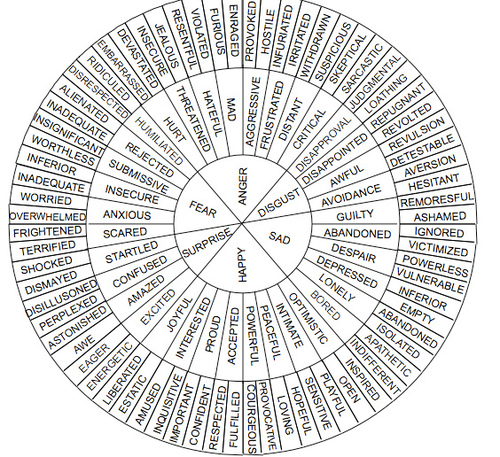
Not sure what to call your feelings and want a handy guide? I got you covered here.

Need more convincing?

If there is a theme for this year that I want to encourage, it is to be fierce with your emotions. To stand up and protect your needs. And a key in doing in that is to understand what your needs are in the first place and to communicate what they are to the people in your environment. You’re the only champion your emotions have. The more you embrace this, the less likely someone can take advantage of you or your emotional state(s).

So, when you are angry, express that you are fucking angry. When appropriate and appropriately. No beating your chest like a gorilla. When you are sad, describe the sadness. Stay with your sadness. Don’t obfuscate. Because you aren’t fooling me. You might be fooling yourself though.

Posted in Mental health therapy, Therapy | Tagged , , , , , , | 2 Comments